A Call for Justice in Iran—Not Another War

Reject the war drums from war hawks — lean into the need for diplomacy, accountability, and enforcement of international law
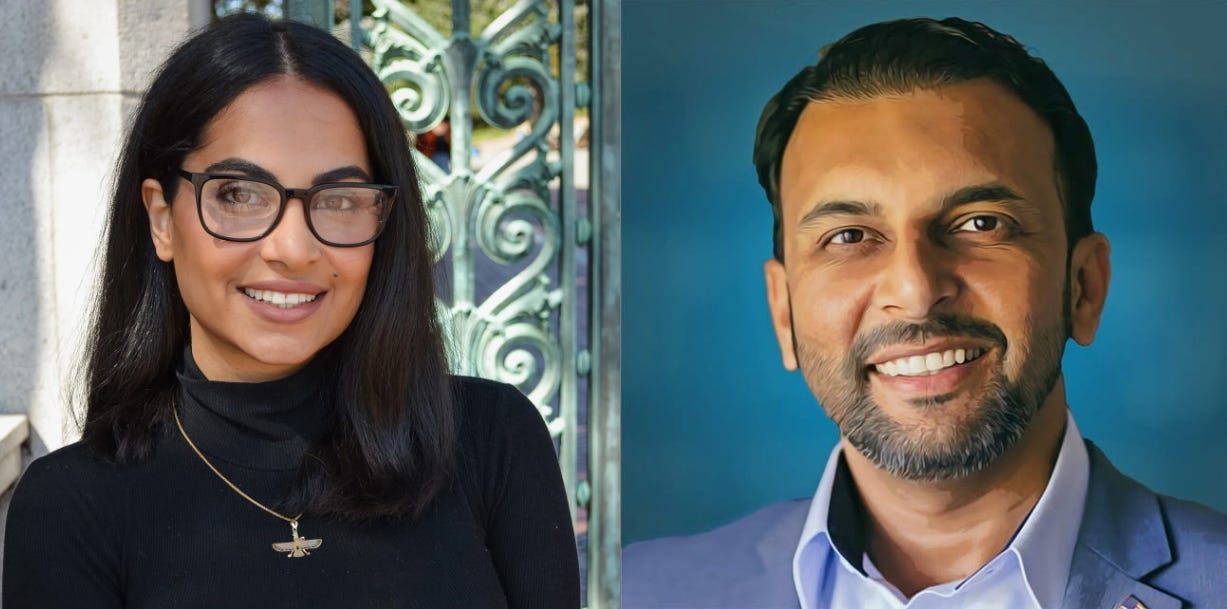
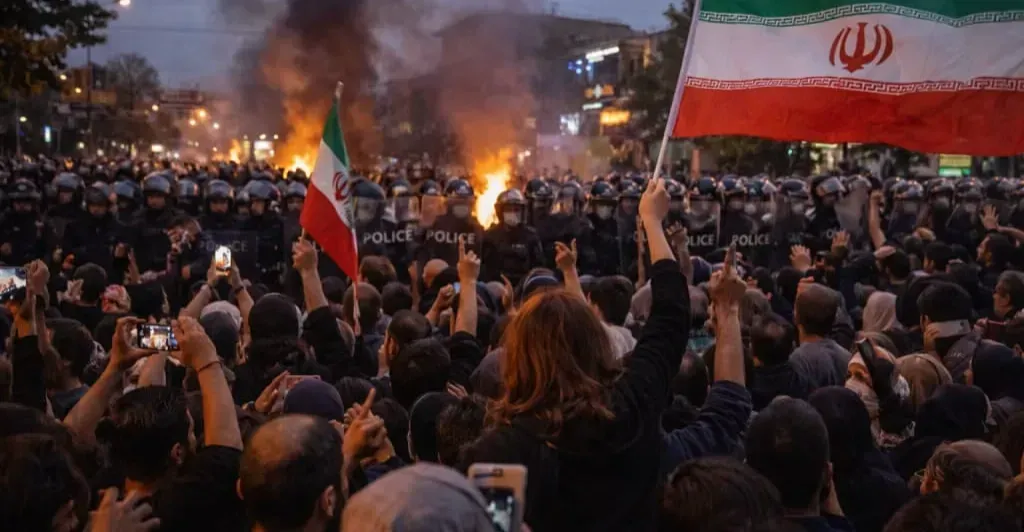
Protests are once again breaking out across Iran. Early reports indicate anywhere from hundreds to several thousands of people have been killed, with tens of thousands arrested. By any measure, an indefensible and horrific atrocity. Families are searching for loved ones. Journalists are being silenced. The internet is restricted. And once again, the Iranian people are paying the price for a system that denies them basic dignity and self-determination. Making matters worse, right now there is immense misinformation and disinformation hitting the airways. Therefore, I am co-writing this piece with Iranian American writer and activist Ariana Jasmine to help provide historical context that led to this point, clarify the current situation, and provide meaningful insight on the justice-based steps needed to truly protect the Iranian people’s safety and security. Let’s Address This.
Let's Address This with Qasim Rashid is a reader-supported publication. To receive new posts and support my work, consider becoming a free or paid subscriber.
The History
To understand how Iran arrived at this moment, we must begin with an uncomfortable historical truth. In 1953, the U.S. government helped overthrow Iran’s democratically elected prime minister, Mohammad Mosaddegh, after he moved to nationalize Iran’s oil for the benefit of its people. That coup dismantled a legitimate democratic experiment and replaced it with decades of authoritarian rule under the Shah—whose brutal repression, backed by Western powers, created the conditions that ultimately enabled the 1979 revolution and the rise of today’s authoritarian theocratic regime.
Likewise, a recent report on declassified CIA documents first reported by the BBC and then published by The Guardian create even more confusion about the extent of foreign interventionism into Iran.
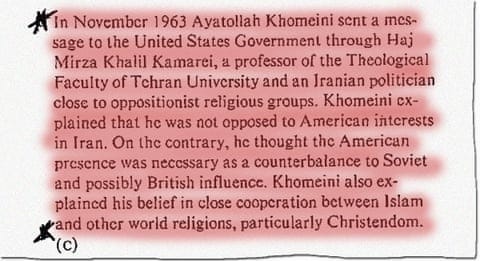
What remains clear is that the Iranian people did not choose a theocracy freely; it emerged from a vacuum left by foreign interference and sustained repression.
The Current Reality
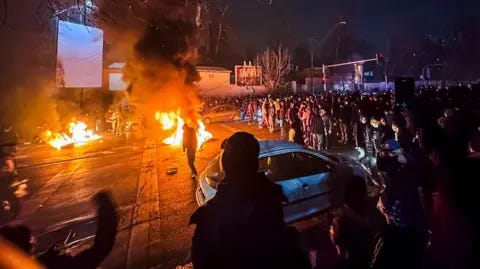
Today, Iran is a theocracy. One that oppresses freedom of conscience, denies women personal autonomy, and operates under religious rule, rather than secular governance. Western sanctions have decimated Iran’s economy, with indications that these current protests that began on December 28th were in response to the Iranian currency becoming near worthless compared to the USD.
For decades, we have both advocated for the Iranian people—not for regime change imposed from abroad, but for secular governance, freedom of conscience, and rule by the people themselves. That remains our position today. Iran’s future must be shaped by Iranians, not by bombs, sanctions, or geopolitical gamesmanship. Western interventionism is not a solution; history shows it is often the problem. Donald Trump’s renewed threats to bomb Iran will not liberate a single Iranian woman, worker, or student. They will only strengthen hardliners and deepen civilian suffering.
We are also witnessing a cynical propaganda cycle. Many pundits who were conspicuously silent—or openly dismissive—during the genocide of Palestinians now claim sudden concern for Iranian lives. This selective outrage is not solidarity; it is opportunism. Do not fall for it. Instead, listen to the scholars, journalists, and human rights advocates who spoke out against the atrocities in Palestine and are now speaking out against Iran’s authoritarian and theocratic repression. Consistency matters in human rights. Silence in one crisis discredits concern in another.
The Future
What, then, is the path forward? It is not more sanctions. Decades of evidence show that broad economic sanctions devastate working people while entrenching authoritarian elites. Nor is it another “regime change” war. The wars in Iraq and Afghanistan offer a grim warning: a Brown University study estimates that 4.5 to 4.7 million civilians died as a result of post-9/11 wars. We do not need to repeat that catastrophe.
And right now as both the United States and Israel threaten to bomb Iran, Iran has promised to retaliate in kind. We do not need this escalation as it guarantees to achieve nothing but create more death and destruction. It will certainly do nothing to help the people of Iran.
The solution lies in international law, diplomacy, and people-centered accountability. Iran is a party to the International Covenant on Civil and Political Rights (ICCPR), which it ratified in 1975. That treaty guarantees, among other rights, freedom of thought, conscience, and religion; freedom of expression and the press; freedom of movement; bodily autonomy; and protection from arbitrary arrest and detention. To be sure, we are not naive about the Islamic Republic, as it is clear that they have completely failed to comply with the ICCPR. But we cite them to document that these are not Western impositions—they are binding legal obligations Iran voluntarily accepted. The international community must insist, through multilateral diplomacy and United Nations mechanisms, that Iran be held to these commitments.
That means supporting independent investigations, protecting journalists and human rights defenders, enabling U.N. engagement, and amplifying—not eclipsing—the voices of Iranians themselves. And yes, the UN’s failure to act to prevent genocide in Palestine painfully exemplifies the UN’s toothlessness. Indeed, as we mentioned above, you will see many pundits who were silent on that genocide, and who condemned the UN and ICC for taking any action at all against the Israeli government, now call on the UN to act against Iran. This hypocrisy is dangerous, and should be discarded. Instead, as Iranian activist and award winning writer, speaker, and artist Ari Honarvar recently told us:
We must commit to what protesters themselves are asking for: solidarity, amplification, targeted sanctions on the ruling class, protecting channels for medicine and life-saving aid, and pressure power structures, especially the armed forces (who have so much power and were instrumental in 1979 revolution) to break with the regime. This centers the people actually risking their lives. Anything else is just managing oppression.
This also means rejecting militarism and collective punishment, and instead demanding accountability grounded in law and human dignity.
Subscribe to Ariana Jasmine on Substack
Conclusion
We have seen where endless war leads. Therefore, this moment demands moral clarity and centering the Iranian people. The suffering of the Iranian people is real, urgent, and intolerable—but exploiting that suffering to justify more violence, more sanctions, or another catastrophic foreign intervention would only compound the harm. We have already seen this pattern play out across the region: external force masquerading as liberation, followed by state collapse, mass civilian death, and generational trauma.
Iran must not become the next chapter in that same failed doctrine.
What justice requires instead is sustained international pressure rooted in law, not militarism; solidarity with Iranian civil society, not domination over it; and an unwavering commitment to universal human rights, not selective outrage shaped by geopolitical convenience. It requires that governments stop using Iranian lives as leverage points in power struggles, and start using every diplomatic and legal mechanism available to protect those lives—now.
The Iranian people are demanding the right to live with dignity: to speak freely, to worship—or not—without fear, to move without coercion, to exist without being crushed by an authoritarian theocratic state or an international system that treats them as expendable. Our responsibility, as members of the global community, is to ensure their voices are heard, their rights are defended, and their struggle is not hijacked for war.
History will judge what we do next. It will remember whether we chose escalation or justice, propaganda or principle, destruction or solidarity. There is still time to choose correctly. Justice for the people of Iran is not only possible—it is the only path forward that does not repeat the gravest crimes of the past.
Let's Address This with Qasim Rashid is a reader-supported publication. To receive new posts and support my work, consider becoming a free or paid subscriber.