
Age of Ayesha, Wife of Prophet Muhammad (sa)

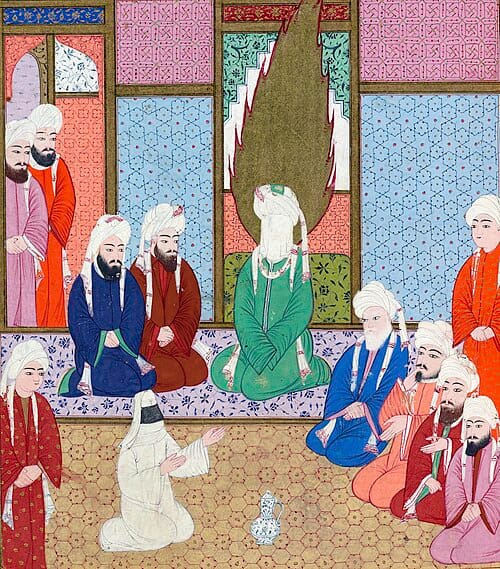
Addressing a growing and meritless accusation against Prophet Muhammad (sa)
Every few years a reckless accusation against Prophet Muhammad (sa) surfaces, one driven by ignorance, hatred, and fear mongering. Prophet Muhammad (sa), the claim alleges, and his wife Ayesha (ra) were wedded when she was a child. It is a vile and entirely meritless allegation. In this article I research the actual history behind this accusation to do the following:
- Provide accurate evidence that Ayesha (ra) was likely between the ages of 18 to 20 at the time of her willing marriage to Prophet Muhammad (sa)
- Provide additional context when compared to contemporary society, and
- Provide clarity why the sources cited by critics are unreliable and untrustworthy.
Let's Address This is a reader-supported publication. To receive new posts and support my work, consider becoming a free or paid subscriber.
Marriage In Western Society
A variety of authentic historical references substantiate this conclusion that Ayesha (ra) chose to marry the Prophet Muhammad (sa) of her own free will, at an age of maturity, and in accordance with human dignity and women’s autonomy.
Before delving into Islamic history, it is necessary to consider that the age deemed “acceptable” to marry is not some objective standard across time, culture, and religion—but a subjective standard based on social construct. For example, the Catholic Encyclopedia reports regarding Mary, mother of Jesus, indicate that she was 12-14 years of age upon her marriage to Joseph (90):
…the priests announced through Judea that they wished to find in Juda a respectable man to espouse Mary, then twelve to fourteen years of age. Joseph, who was at the time ninety years old, went up to Jerusalem among the candidates; a miracle manifested the choice God had made of Joseph, and two years later the Annunciation took place. [1]
Likewise, the Talmud recommends “marrying off one’s daughter as soon after she reaches adulthood as possible, even to one’s Slave.” [2] In fact, the Talmud presents some peculiar guidance on marriage, also stating:
A maiden aged three years and a day may be acquired in marriage by coition, and if her deceased husband’s brother cohabits with her, she becomes his. [3]
I cite these not to attack Christianity and Judaism, but to demonstrate to those spreading misinformation about Prophet Muhammad (sa) to reflect on these traditions first—as these traditions also informed marriage laws in the West. And as we consider marriage laws in the West, which we are constantly (and incorrectly) told are “Christian nations,” we find additional concerning realities.
For centuries in Scotland, the age of consent for girls was twelve—and parental consent was unnecessary. [4] Only in 1929 was the age raised to sixteen for girls. [5] In America even today, child marriage is rampant, with Unchained At Last documenting at least 300,000 cases of child marriage since the year 2000—sanctioned by the church and by the courts. For example, in New Hampshire, the legal age for girls was thirteen with parental consent, until child marriage was finally banned in June, 2024. [6] In Massachusetts, the legal age for girls was twelve with parental consent, before child marriage was finally banned in July, 2022. [7] In Mississippi, there is no age minimum for girls, as long as there is parental consent. [8] In California, there is no age minimum for girls, as long as there is parental consent. [9] Overall, more than 30 states to this day in 2025 deem child marriage as legal.
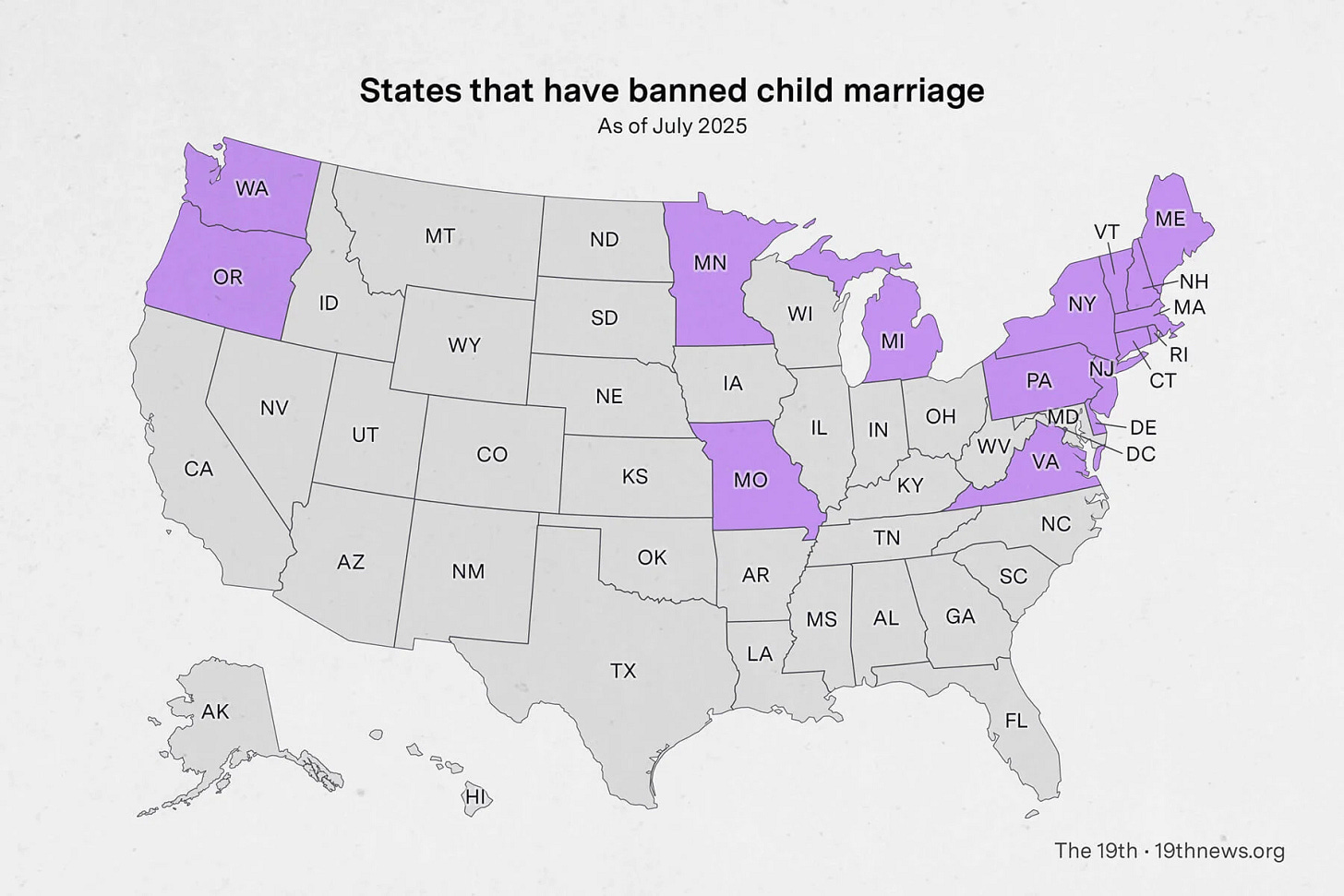
This exercise in no way defends child marriage—indeed I have written at length condemning this horrid practice. Rather, I cite this data to establish the point that “appropriate” marriage ages are based on ever-changing social constructs—not some supposed objective, advanced contemporary standard. Those accusing Prophet Muhammad (sa) of any impropriety should first address the Old Testament, New Testament, Europe, and more than 30 American states.
How shocking is it that American marriage laws still permit child marriage as you read this? As mentioned earlier there have been over 300,000 documented child marriages in America since the year 2000, with some children as young as 11—sanctioned by the church and the courts. [10] Again, I cite this to point out how critics of Prophet Muhammad (sa) cite inconsistent information to allege him of wrongdoing while remaining silent on this documented epidemic of child marriage in America.
Turning to the point at hand directly, Ayesha’s (ra) marriage to Prophet Muhammad (sa) was at her age of maturity and was not unusual when compared across time and culture—even by today’s standards. Finally, the assertion that Ayesha (sa) was only six years old is meritless. Below I address this claim in detail.
Addressing The Accusation Directly
Those accusing Prophet Muhammad (sa) of this claim cite a few inauthentic narrations alleging Ayesha’s (ra) age six at time of marriage and nine at time of consummation. I explain why this conclusion is entirely meritless.
A hadith is what we call a recorded saying or teaching of Prophet Muhammad (sa). Prophet Muhammad (sa) forbade writing down his hadith during his lifetime to ensure they would not inadvertently be mixed in with the Holy Qur’an. Accordingly, most ahadith (plural of hadith) were written decades, even centuries after Prophet Muhammad (sa) died. Thus, a detailed system was established to determine veracity and authenticity of a hadith, before it was accepted. While the extensive discussion of that science is beyond the scope of this article, I can share this in brief: In determining hadith authenticity, it is necessary to consider how many different narrators can relate a hadith back to the original source—be that source Prophet Muhammad (sa), Ayesha (ra), or a companion. The more consistent narrators exist and the more in agreement they are with one another—the more authentic we may consider the hadith. The hadith alleging that Ayesha (ra) was a child are inconsistent, unreliable, and singular in their statements. Meanwhile, the multiple documented hadith affirming Ayesha (ra) at an age of maturity and adulthood are many and irrefutable.
Below I compare and contrast both accounts to demonstrate just how clear of a distinction exists between the false allegation and the truth of the matter. To start, I cite the multiple, verified sources demonstrating the actual age of Ayesha (ra) as an adult.
The Actual Age of Ayesha (ra)
Several historical events and ahadith narrations demonstrate that Ayesha (ra) was likely 18 to 20 at the time of her consenting marriage to Prophet Muhammad (sa). Critics ignores each of these. Accordingly, here are just three of the many arguments that affirm Ayesha’s age as between 18 and 20.
Point One
First, Hadhrat Ayesha was the daughter of Hadhrat Abu Bakr. The 10th century polymath and scholar al-Tabari reports, “All four of [Abu Bakr’s] children were born of his two wives…during the pre-Islamic period [i.e., pre-610 AD].” [11] Likewise Ayesha (ra) herself reports she recalls her early life in the years before Islam in Mecca. This indicates she would have been around four our five years old in the year 610, when Islam was first revealed to Prophet Muhammad (sa). And finally, it is likewise well documented that Ayesha’s (ra) marriage to Prophet Muhammad (sa) took place one year after Hijra (emigration to Medina), or around 624 AD.
Therefore, even if Hadhrat Ayesha had been born as late as 605 AD, she would have been roughly 18 at the time of emigration to Medina in 623 and therefore no less than 19 at the time of her marriage to Prophet Muhammad (sa) in 624. This is a far cry from the age of six that critics assert. But this is not the only piece of corroborating evidence that Ayesha (ra) was 18-20 at the time of her marriage.
Point Two
Second, most historians report that Asma (ra), who was Ayesha’s (ra) elder sister, was 10 years her senior. [12] The books Tahzibut Tahzib and Al-Bidaayah wa an-Nihayah both report that Asma (ra) died at the age of 100, in 73 AH (695 AD). [13]
This means that Asma (ra) must have been no younger than 27 at the time of emigration. As mentioned before, Ayesha’s (ra) marriage to Prophet Muhammad (ra) was in 1 AH or by some sources 2 AH, when Asma (ra) was 28. This means that at a minimum, Ayesha (ra) was 18 or 19 upon her consenting marriage to Prophet Muhammad (sa).
Point Three
Third, it is interesting to note that none of the opponents of Prophet Muhammad (sa) objected to this marriage during or after his lifetime. Such individuals, who wasted no excuse to oppose and malign the Prophet, remained completely silent on this allegedly inappropriate marriage. How could that be? The only logical explanation is that there was nothing objectionable about this marriage because it was between two mature partners who both consented. It is simply ludicrous to assume that critics 1400 years after Prophet Muhammad (sa) are a better judge of his character and acts than were his contemporaries.
Prophet Muhammad (sa) himself made this argument when he recited the Qur’an, “I have indeed lived among you a whole lifetime before this. Will you not then understand?” [14] In this verse, Prophet Muhammad’s (sa) critics are reminded to reflect upon his entire life and cite a single flaw in his character, a single injustice he committed, or a single lie that he told. History records that not a single contemporary—friend or foe, ally or adversary—could cite a flaw in Muhammad’s (sa) life prior to or after his claim to prophethood. Accordingly, history records that any criticism he received after his claim to prophethood was not of his character or acts, but of the claim to prophethood itself. In other words, the historical record reflects that Prophet Muhammad (sa) lived a demonstrably flawless and truthful life—so much so that even those who sought to kill him for his claim to prophethood and his message, could not find flaw with his morals or behaviors.
Additional Arguments
In addition to the above powerful and multiple arguments establishing Ayesha’s (ra) maturity and adulthood, here are a few additional points to consider.
- Prior to her engagement to Prophet Muhammad (sa), Ayesha (ra) was engaged to a man named Jubayr ibn Mut’im. That engagement broke off due to Ayesha (ra) and her family accepting Islam. This establishes two facts. One, Ayesha (ra) was already deemed old enough according to social norms to be engaged for marriage. There was no precedent in Arab culture where a 6-year-old would be married. Indeed, no critic of Prophet Muhammad (sa) can cite to any such norm, because it did not exist. Thus, even prior to her marriage to Prophet Muhammad (sa), Ayesha (ra) was already deemed of a mature age to be married. Two, Ayesha was already old enough to be firm in her faith in Islam and choose to be Muslim. Islam mandates that a woman cannot be forced into marriage, and must give her willing consent. Accordingly, Ayesha (ra) was old enough to affirm that she did not want to marry someone who was not Muslim. While we do not have exact dates, we can ascertain that this happened when Ayesha (ra) was old enough to recognize the importance of marrying a partner who shared faith and values. This is a compelling argument that Ayesha (ra) was likely in her teens at that engagement, and arguably well into her twenties at the time of her marriage to Prophet Muhammad (sa).
- The Arabic word that Ayesha’s (ra) contemporaries, as documented in history books, use to describe Ayesha (ra) at the time of migration from Mecca to Medina in 622 CE was not tifla, which translates to “small child.” Instead, the word used to describe Ayesha (ra) at that time was Jariyah, which translates to “young woman.” The Arabs were a people extremely proud of the eloquence and precision of their language. It is simply nonsensical that they would consistently describe someone as a “young woman” if she was not, or vice versa.
- Prophet Muhammad (sa) and his first wife Khadija (ra) were married for 25 years, until her death due to the harms caused by violent persecution against the early Muslims. When they married in 595 CE, the Prophet Muhammad (sa) was 25, and Khadija (ra) was 40, twice widowed, and had (accordingly to most scholars) 4-5 children. I share this context because it speaks to the character of Prophet Muhammad (sa) as a man who respected women, never exploited them. He showed us who he was as he lived a noble, virtuous, and loyal life to his wife for 25 years. The idea that he was driven by any other cause finds no merit throughout his life. It is foolish to attribute an accusation to him when his entire life, laid public for all the world to see, exemplifies to the contrary. Indeed, the Qur’an Chapter 4, Verse 20 declares, “Inherit not women against their will.” This comprehensive verse commands men that no act should take place without a woman’s willing and able consent. Had the Prophet Muhammad (sa) engaged in any act with Ayesha (ra) that violated this principle, his opponents would have been the first to publicly call him out or ridicule him for such an act. But we find not a single example of such alleged hypocrisy. On the contrary, none other than Ayesha (ra) herself declared about her husband, “Muhammad (sa) is the walking Qur’an.” A descriptor she gave because she saw firsthand how he exemplified every teaching of the Qur’an to its highest possible fulfillment, and without the tiniest scintilla of hypocrisy.
What Critics Get Wrong
So let’s now address the final question—what about the alleged documented pieces of evidence that Ayesha (ra) was “6 years old” at the time of her marriage? The critics making these accusations against Prophet Muhammad (sa) make two fatal mistakes.
First, they ignore all the aforementioned evidence validating with certainty the age of Ayesha (ra) as a mature adult at the time of her consenting marriage to Prophet Muhammad (sa). In their world view, this evidence simply does not exist. That is not the mark of an honest broker. But that behavior also explains their second fatal mistake—they accept unqualified and weak claims.
Second, the allegations they make against Prophet Muhammad (sa) stem from a report narrated by a man named Hisham ibn Urwah (680 CE - 763 CE). This is problematic for several reasons. Centuries ago numerous scholars already documented that Hisham was not a reliable narrator of hadith, and explained why. It is critical we review that history—especially because the critics launching this accusation against Prophet Muhammad (sa) do no such thing.
The First Problem
First, Hisham ibn ‘Urwah, an early Islamic scholar and hadith transmitter, is the only person to narrate this hadith alleging an age of six for Ayesha (ra). That only a single narration exists eliminates the opportunity for corroboration and validation. Moreover, it is not even a hadith that is attributed to Prophet Muhammad (sa), but to other persons, further demonstrating the weakness of the claim. This matters because when scholars began writing the hadith of Prophet Muhammad (sa) decades after he died, they paid particular attention to accuracy for statements attributed to him. Accordingly, more than 97% of the hadith attributed to Prophet Muhammad (sa) were discarded due to the lack of evidence validating that he actually said what he said. (Reminder, Prophet Muhammad (sa) forbade writing down his hadith during his lifetime to ensure they would not inadvertently be mixed in with the Holy Qur’an). But that level of accuracy was not necessarily maintained for other personalities. Thus, this singular statement as recorded by Hisham ibn Urwah has no real or meaningful corroboration. But the problems with this narrative only increase from here.
Second, it is well documented Hisham related this hadith in his old age and after he migrated to Iraq—a time during which he admits he suffered severe memory loss. For example, Tahzibut Tahzib, a premier book on the credibility of hadith narrators, cites Yaqub ibn Shaibah to report, “Narratives reported by Hisham are reliable except those that are reported through the people of Iraq.”153 Likewise, “Malik ibn Anas objected on those narratives of Hisham which were reported through people of Iraq.”154
History records that after living in Medina for the first 71 years of his life, Hisham immigrated to Iraq in his old age and suffered severe memory loss. 155 More specifically, Yaqub ibn Shaibah relates, “He [i.e., Hisham] is highly reliable, his narratives are acceptable, except what he narrated after shifting to Iraq.”156
The hadith that alleges Ayesha’s (ra) age as six at marriage was related by Hisham ibn ‘Urwah after he immigrated to Iraq, after the year 751 CE. That is more than 130 years after Prophet Muhammad (sa) and Ayesha (ra) were married. And we have multiple scholars all in agreement that hadith Hisham related after moving to Iraq are simply not reliable. All that notwithstanding, as a thought exercise, how many people reading this could confirm with accuracy the age of anyone who lived in the late 1800s using only verbal narrations of those alive today?
Third, thus, this hadith is not only isolated in its claim but also unreliable due to Hisham’s old age and admitted extensive memory loss. Combined with numerous documented and written historical records establishing that Ayesha (ra) was between 18-20 at the time of her consenting marriage to Prophet Muhammad (sa), it is clear that the only people pushing this false claim of underage marriage are ignorant at best, and in reality quite malicious. To rely on singular information that is already regarded as inaccurate and unreliable, and to ignore multiple pieces of evidence that all corroborate one another, is not research or honesty—it’s propaganda.
Conclusion: Learn Islam Through Scholars, Not Slander
If there’s one lesson we must draw from this persistent false accusation against Prophet Muhammad (sa), it’s that Islam must be learned through scholars—not slander. The truth of our faith cannot be entrusted to those whose only intent is to defame, distort, or destroy. These critics are not seekers of truth. They are propagandists who weaponize ignorance, hoping that repetition will replace research, and outrage will replace understanding.
But Islam is not a faith that hides from scrutiny. It is a faith that invites inquiry, celebrates knowledge, and treasures academic integrity. As this article has shown, the false claim regarding Ayesha’s (ra) age is easily dismantled when examined through the lens of qualified scholarship, historical records, and contextual truth.
That is the very purpose of my platform. I founded this publication not merely to react to hate, but to offer clarity where there is confusion, scholarship where there is misinformation, and nuance where there is noise. I am deeply grateful to each of you who has placed your trust in this work—who reads, shares, subscribes, and supports this effort to uplift honest, rigorous, and spiritually rooted conversations about Islam.
In a time when so many voices speak about Islam without understanding it, this platform is a space where we speak from Islam, with humility, scholarship, and truth.
May we all be among those who learn with open hearts, seek knowledge with sincerity, and defend justice with grace.
Thank you for being part of this journey.
Let's Address This is a reader-supported publication. To receive new posts and support my work, consider becoming a free or paid subscriber.
References
[1]. The Catholic Encyclopedia: An International Reference of Work on the Constitution, Doctrine, Discipline, and History of the Catholic Church, vol 8. (New York: Robert Appleton Company), 505.
[2]. Talmud, Pesachim 113a.
[3]. Talmud, Sanhedrin 55b.
[4]. E. Ewen, “The early modern family” in T. M. Devine and J. Wormald, eds, The Oxford Handbook of Modern Scottish History (Oxford: Oxford University Press, 2012), 271.
[5]. Ibid.
[6]. Entry for New Hampshire at http://topics.law.cornell.edu/wex/table_marriage#g.
[7]. Entry for Massachusetts at http://topics.law.cornell.edu/wex/table_marriage#g.
[8]. Entry for Mississippi at http://topics.law.cornell.edu/wex/table_marriage#g.
[9]. Entry for California at http://topics.law.cornell.edu/wex/table_marriage#g.
[10]. https://www.unchainedatlast.org/wp-content/uploads/2021/08/Study-PDF-FINAL-1.pdf
[11]. Al-Tabari, Tarikh al-umam wal-mamloo’k, vol. 4 (Beirut: Dar al-fikr, 1979), 50.
[12]. Imam Az-Zahabi, Siyar A`la’ma’l-nubala’, vol. 2 (Beirut: Mu’assasatu’l-risala’h, 1992), 289.
[13]. Ibn-e-Kathir, Al-Bidaayah wa an-Nan-Nihaayah, vol. 8 (Al-jizah: Dar al-fikr al-`arabiy, 1933), 371–372.
[14]. Qur’an 10:17.
153. Ibn Hajar Al-‐`Asqalaani, Tahzibut Tahzib, Dar Ihya al-‐turath al-‐Islami, vol. 11, 48–51.
154. Ibid.
155. Meezaanal-‐Ai`tidal, Vol. 4, pg. 301–302.
156. Tahzibut Tahzib, 50.