Illinois Is On the Cusp of Something Historic


How you can help the RIFL Act become law, and pass one of the biggest wins for gun safety legislation in American history
This is a guest piece by Lauren Harper & Dr. Anthony Douglas II, MD MPH. It concludes with an important call to action. A call I hope every person reading this completes. It will take you less than 60 seconds, and will play a vital role to ensure Illinois passes this critical life-saving piece of gun safety legislation. Let’s Address This.
Lauren Harper is a gun violence prevention advocate and grassroots organizer with a passion for solving the root causes of gun violence in Illinois.
Dr. Anthony Douglas II, MD MPH, is a surgical resident at the University of Chicago and founder of the nation’s first Surgical Advocacy Fellowship.
Qasim Rashid is a human rights attorney, author, and host of Let’s Address This. Share, subscribe, and let’s remain relentless in our mission for a more perfect Union.
Guest Post: A New Era of Gun Safety Is In Our Grasp
By: Lauren Harper & Dr. Anthony Douglas II, MD MPH
We are writing to you at a moment of compounding crisis—and compounding opportunity.
The Trump administration’s assault on the everyday lives of working Illinoisans is not abstract. It is measurable. It is documented. And it is deepening by the month. Illinois now faces a projected $267 million deficit in the current fiscal year, driven in part by federal tax cuts, tariffs, and declining consumer spending. This shortfall is projected to balloon to $2.2 billion next year as new federal policies require the state to pay more for social service programs while receiving less federal funding.
Nearly 1.9 million Illinoisans risk losing SNAP food benefits — benefits that have served as a lifeline for working families, children, veterans, and people with disabilities for six decades. Nearly 1 million Illinois households received SNAP benefits in February 2026, and over 250,000 households are affected by the changes enacted through H.R. 1. Nearly 400,000 additional people in Illinois may lose their SNAP benefits amid new paperwork requirements to demonstrate employment.
Gas prices remain elevated. Groceries cost more. The activities of daily living—the simple, basic things that make a life livable—are increasingly out of reach for the families we serve and the communities we work in. And beneath all of it runs a current that those of us in gun violence prevention know intimately: desperation and poverty are among the most powerful drivers of gun violence.
Which is why the data coming out of the first quarter of 2026 cannot be ignored.
The Warning Signs Are Here
Earlier last year, we celebrated a remarkable milestone: Chicago recorded its lowest homicide count since 1965, dropping from 587 homicides in 2024 to 416 in 2025—a stunning 30% reduction. As we wrote then, that drop happened for identifiable reasons. A decade of common-sense gun legislation, combined with the painstaking, hyperlocal work of community violence intervention (CVI) organizations doing street outreach, de-escalation, and healing work in the neighborhoods that needed it most.
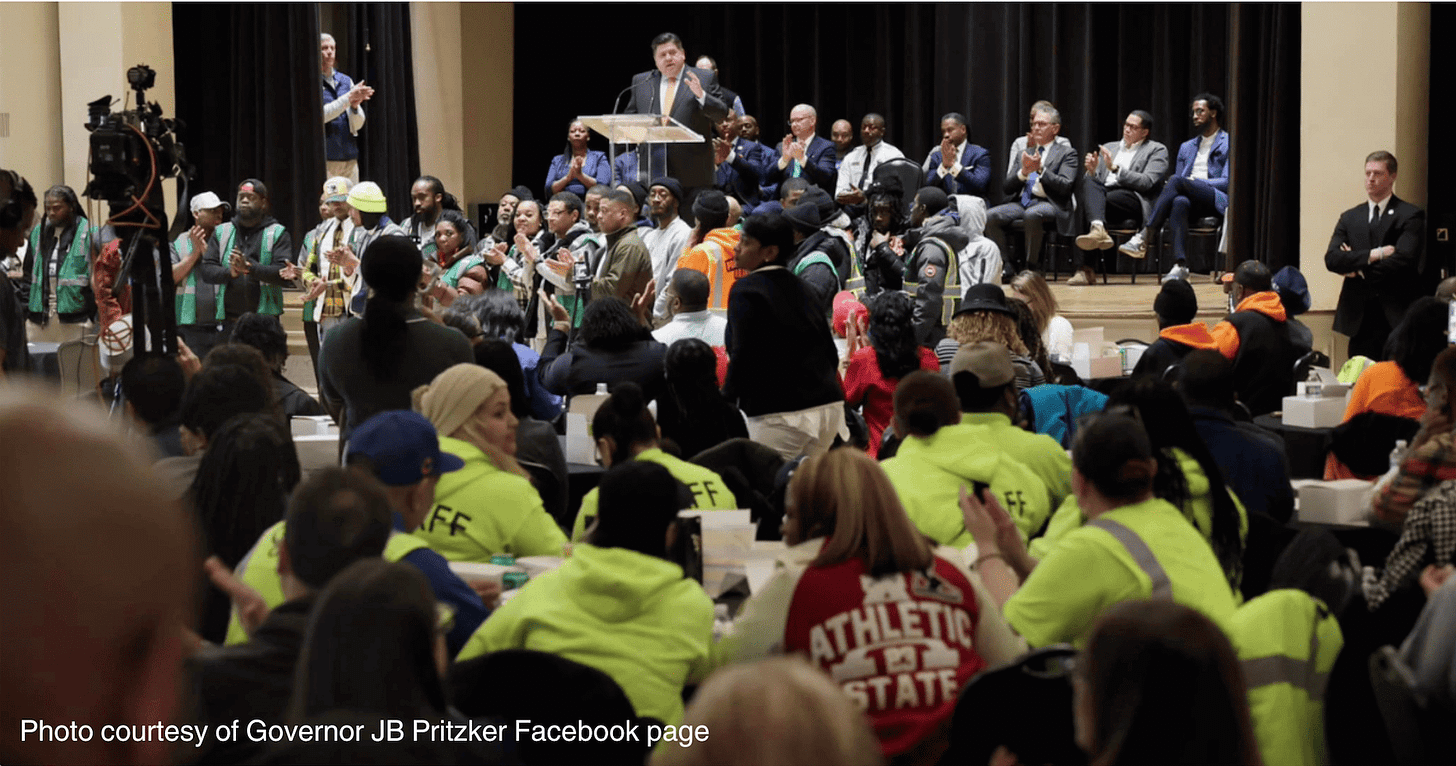
We said then that this progress was fragile. We were right.
After four consecutive years of steep drops in gun violence, shootings in Chicago ticked up in the first quarter of 2026. The city recorded 105 murders through the first week of April, up slightly from the 98 killings seen in the same time period in 2025. Another 266 people have suffered nonfatal gunshot injuries since the start of the year.
Through the first three months of 2026, the number of shootings and shooting victims are up 4% and 5%, respectively, compared to the first three months of 2025.
And the connection between this uptick and federal funding cuts is not speculative. It is being stated plainly by the people doing the work on the ground. Bob Jackson, CEO of the anti-violence group Ceasefire in Roseland, said in a statement that the increase in violence has coincided with federal funding cuts to organizations such as his. “Since the cuts, so many organizations have reduced their workers. As the numbers decrease, you have fewer people on the streets doing the work. Now, we’re seeing the violence begin to tick up.”
This is the feedback loop we warned about. Cut funding to organizations preventing violence. Watch violence rise. The people who pay the price are not in Springfield. They are in our neighborhoods, in our emergency rooms, in our operating theaters.
A recent study by University of Chicago researchers linked evictions and gun violence directly, finding that a 1% increase in the eviction rate in a census tract was associated with 2.66 additional shootings within 1,000 feet of a person’s home. As SNAP cuts strip food security from nearly 2 million Illinoisans, as evictions rise in the wake of economic instability, as safety nets fray—the conditions that produce gun violence are being actively manufactured by federal policy.
We do not have the luxury of waiting for better federal conditions. We need an Illinois solution. The good news is, we have one.
The RIFL Act: Built for Exactly This Moment
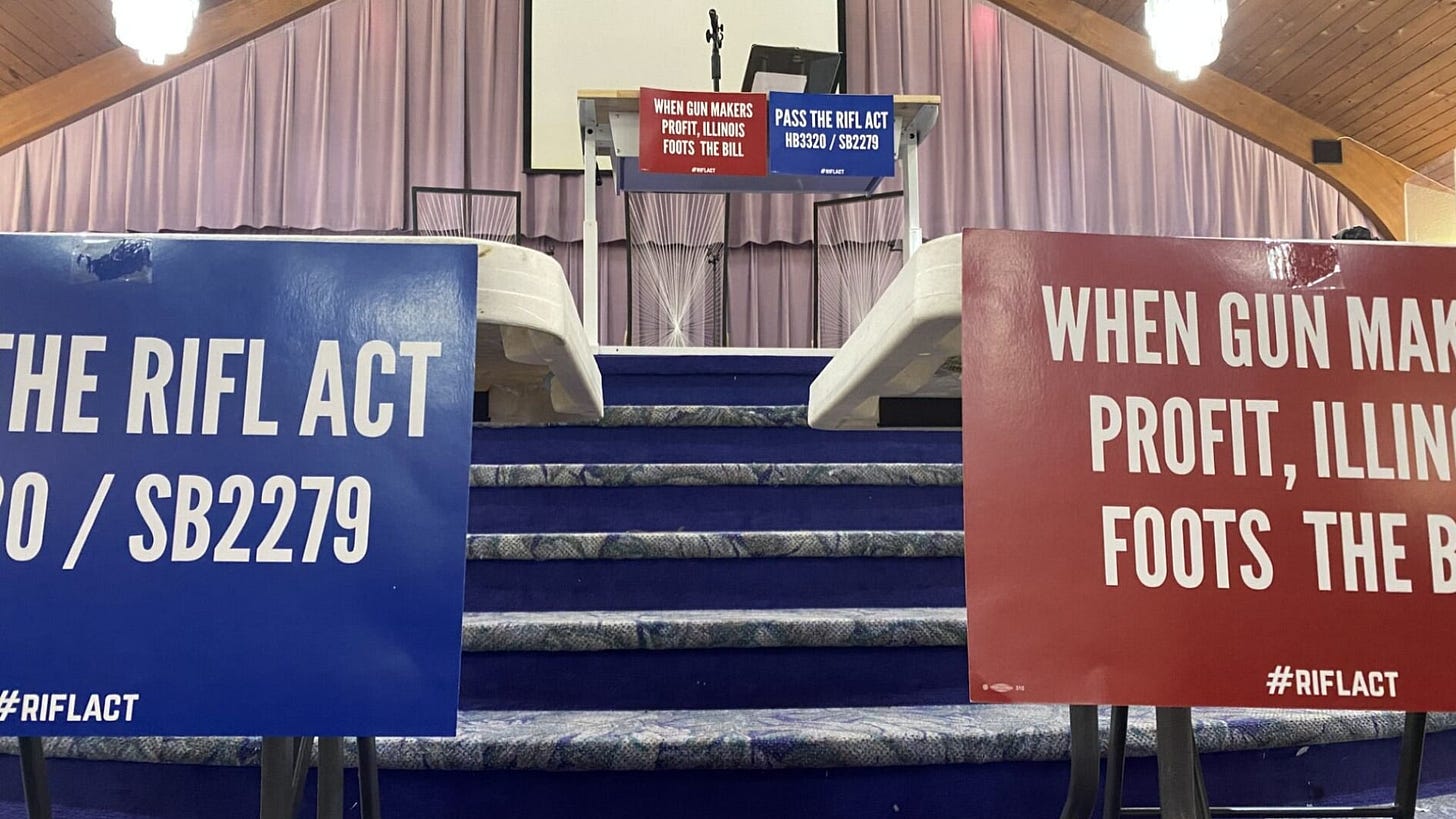
The Responsibility in Firearm Legislation Act—the RIFL Act, HB3320/SB2279—is not a reaction to this crisis. It is a structural solution designed for precisely this kind of moment, when federal funding disappears and communities are left to absorb the costs of an industry that has never been required to share them.
But mention the RIFL Act, and critics put up two objections. One, that it’s allegedly unpopular in Illinois. And two, that it won’t work. Let’s tackle each of these objections with facts—because lives are at stake.
CLAIM 1: Downstate Illinois Doesn’t Support the RIFL Act
Fact: The assumption that support for gun safety legislation evaporates south of the Chicago city limits is just that, an assumption. And now we have data disproving this myth.
In partnership with Change Research, we commissioned a survey of downstate Illinois voters—Central Illinois, Southern Illinois and the collar counties. The results shatter the narrative that this is a Chicago issue, or a Democratic issue, or an urban issue.
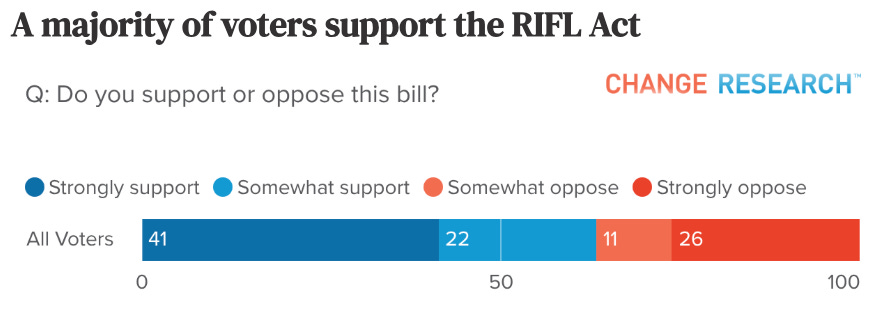
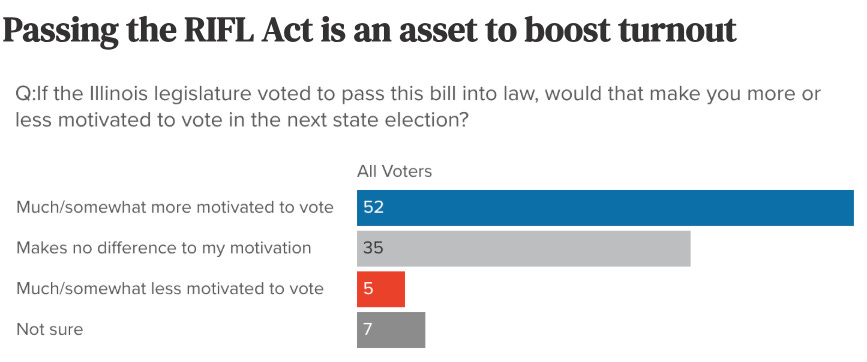
The downstate survey showed broad support for the RIFL Act, with 63% of voters in favor across all 10 downstate Senate districts. Passing the RIFL Act was a voter turnout asset. 52% of voters said it would make them more motivated to vote in November, while 35% said it wouldn’t affect their motivation either way.
50% of gun owners who took the survey support the RIFL Act measure. The people of Illinois—across geography, across party, across the divides that Springfield often considers during election years for controversial topics—support making gun manufacturers pay their fair share for the public costs and harms their products create. This is not a controversial idea to ordinary Illinoisans.
It is common sense.
And in a re-election year, as legislators statewide calculate what their constituents want, the data could not be clearer: their constituents want the RIFL Act.
CLAIM 2: The RIFL Act Won’t Work
Quite simply put, the facts are overwhelming at how effective the RIFL Act will be to save lives. Right now the average hospital bill for a gunshot victim is $82,000, and gun violence costs Illinois up to $20 billion annually. For a detailed analysis on how the RIFL fixes these egregious injustices, see our previous piece on Let’s Address This, where we lay it out in full detail.
But here’s the short version. Right now, firearms manufacturers pay nothing for the harm their products cause in our communities.
The RIFL Act changes that equation because it funds proven gun violence prevention and it restructures incentives. Today, gun manufacturers profit when gun violence spikes—increased fear drives increased sales. The RIFL Act flips the paradigm. If a manufacturer’s guns are consistently recovered in incidents of injury and death, they pay more. This means manufacturers have a direct financial incentive to invest in safer products, to rebuke gun trafficking, to support safe storage education, to recall products compatible with lethal modifications like switches. As Safe Illinois CEO Sara Knizhnik put it: “Instead of working against us as we fight to reduce gun violence, the RIFL Act gives firearm manufacturers a reason to work with us.”
The CVI organizations that saved thousands of lives in 2025 are fighting to exist in 2026 because of federal funding cuts. The neighborhoods that finally began to breathe after years of violence are watching those gains erode in real time. The manufacturers who profit from the violence and devastation created by their for-profit activity are still paying nothing toward the cost of that harm.
The RIFL Act resolves all three of these problems simultaneously, by:
- Addressing the gap in funding for CVI work independently of federal whims.
- Stabilizing the gains that took a decade to achieve.
- Holding an industry accountable that has watched as their products have leveled our communities.
The model is ready to go national—but Illinois must first lead the way.
The Moment Illinois Must Seize
We are in the final weeks of the Illinois General Assembly session and The RIFL Act has the votes in both the House and Senate Chambers to pass. If passed, Illinois becomes the first state nationwide to implement cost-sharing for the firearm manufacturing industry. This will save Illinois an estimated half a billion dollars over three years. The RIFL Act will create a new era, similar to what we witnessed in the automotive industry of self-regulation, safer innovation, and harm reduction.
And make no mistake—this win will go national. New York, Minnesota, Hawaii, Connecticut, and Virginia are already watching, ready to follow Illinois’s lead the moment it passes here. The time to save lives is always now.
And here’s how you can help seal this victory.
What You Can Do
If you live in Illinois, see #1 below. If you do not live in Illinois, skip to #2 below.
- IF YOU LIVE IN ILLINOIS: Contact your legislators and Governor Pritzker by clicking on the button below. Let them know that Illinoisans across the state support the RIFL Act and expect action before the legislative session closes.
When you click on the below button, it’s an easy 3 step process.
- Step 1: Enter your address so we can correctly identify your Illinois State Rep and State Senator.
- Step 2: Add a few words or one sentence on why you support the RIFL Act. We will use your words to build a thorough message to send to your elected officials.
- Step 3: Hit submit, and send your message to your elected officials
Email Your State Official
- IF YOU DO NOT LIVE IN ILLINOIS: You can still help us pass the RIFL Act. Please take one, two, or all three of the below actions.
- Action 1: Forward this article to everyone you know in Illinois, and share it on your social media platforms. Tag RIFL Act Coalition on Facebook and IG at @rifl_illinois.
- Action 2: Sign our open petition to help us advance the RIFL Act nationwide.
Sign Our National Petition
- Action 3: Donate to our efforts to advance gun safety legislation nationwide.
Donate to Advance the RIFL Act
In Closing
The future is bright. We have made immense progress, and you can help us secure our first major legislative victory. Take two minutes to email your state legislator right now. The gun industry is counting on public silence. Disappoint them.
The data is clear. The people are ready. The bill is due.
Pass the RIFL Act.
This piece is a guest contribution to Let’s Address This with Qasim Rashid. To read our previous coverage of the RIFL Act and Chicago’s historic 2025 homicide reduction, click here.