What Is A Dhimmi In Islam?

What Islam Really Teaches About Dhimmis and Jizya: A Response to Common Misconceptions
Most people have never before heard the word “Dhimmi.” Like the word Jihad, it’s often misrepresented to create fear and disinformation. This week I received the following bizarre hate message:
While others fight against white-supremacy out of good faith, muslims do it out of an Islamic interest to establish Islamic rule and whitewash Islamic colonialism and Islamic supremacy. Dont ever think a Muslim is on your side. Qasim writes "to build a society of true equity and justice for all" I encourage everyone to google what a Dhimmi is.
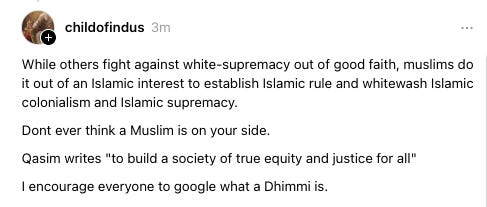
While much of his comments are nonsense, I appreciated his final sentence that encourages everyone to “google what a Dhimmi is.” As I’ve written before, Islam invites scrutiny and critique. Accordingly, I’m happy to answer this question. What exactly is a Dhimmi in Islam, and as a bonus, what is the concept of Jizya in Islam?
Let's Address This is a reader-supported publication. To receive new posts and support my work, consider becoming a free or paid subscriber.
What Is a Dhimmi?
I begin with a proper explanation of what exactly a dhimmi is.
Dhimmi is a historical term referring to non-Muslim subjects of a Muslim run government.1 The word literally means “one whose responsibility is taken” or “people with whom a covenant or compact has been made.”2 The word describes citizens of a Muslim state afforded security over their persons, property, and religious practice in return for a tax (the jizya). Historically, when empires won battles and wars, common people were subjugated, looted, and forced to work as laborers and serve in the military. Islam did away with such practices by affording all non-Muslims the special dhimmi status.3 History records that dhimmis had a special place in Medina. Prophet Muhammad (sa) said:
“If anyone wrongs a man with whom a covenant has been made [i.e., a dhimmi], or curtails any right of his, or imposes on him more than he can bear, or takes anything from him without his ready agreement, I shall be his adversary on the Day of Resurrection.” (Sahih Abu Dawud, #3052)
Prophet Muhammad (sa) also made it clear that protecting the lives and honor of dhimmis was the responsibility of the Muslims, and failing in this regard would incur God’s wrath:
“Whoever killed a Mu’ahid (a person who is granted the pledge of protection by the Muslims, i.e. a dhimmi) shall not smell the fragrance of Paradise though its fragrance can be smelt at a distance of forty years (of traveling).” (Sahih Bukhari Vol. 9, Book 83, #49)
At the conquest of Mecca, Prophet Muhammad (sa) had the upper hand against those who had persecuted him for more than two decades. He could have silenced his enemies forever. Instead, he turned to the Meccans and asked:
“O’ Quraish! How do you think I would treat you?”
They replied: “We expect nothing but good from you as you are a noble and kind brother to us and the son of a noble and kind brother as well.”
The Prophet said, “I say to you what the Prophet Joseph said to his brothers: ‘No blame against you! You are free.’” (Zadul-Ma’ad, vol. 1 424).
Even before the conquest of Mecca, the Charter of Medina set the precedent for the treatment of mua’ahids (dhimmis are those non-Muslim subjects who become subjects after a war. If there is no war and there is a negotiated settlement, then they are called mua’ahids). When Prophet Muhammad (sa) was popularly appointed Medina’s ruler, he entered into a pact with the Jewish communities of Medina. Through this pact, he granted equal political rights to non-Muslims. They were ensured complete freedom of religion. They were not required to take part in the religious wars of the Muslims, but they were required to fight a common enemy of the state. Even as the head of state, Prophet Muhammad (sa) afforded non-Muslims the same social status he afforded Muslims. For example:
“Once a funeral procession passed before Prophet Muhammad (sa) and he stood up [out of respect]. He was told that he [the dead man] was a Jew. Upon this he remarked: ‘Was he not a human being or did he not have a soul?’” (Sahih Muslim, Book 4, #2098).
After the Prophet Muhammad’s (sa) demise, non-Muslim inhabitants of the fast-expanding Islamic empire enjoyed the same dignified treatment. When Khalifa Umar (ra), second khalifa of Prophet Muhammad (sa), conquered Jerusalem, he entered into a pact with all inhabitants of the city, declaring:
In the name of Allah, the most Gracious, most Beneficent. This is a covenant of peace granted by the slave of Allah, the commander of the faithful ‘Umar to the people of Jerusalem. They are granted protection for their lives, their property, their churches, and their Crosses, in whatever condition they are. All of them are granted the same protection. No one will dwell in their churches, nor will they be destroyed and nothing will be reduced of their belongings. Nothing shall be taken from their Crosses or their property. There will be no compulsion on them regarding their religion, nor will any one of them be troubled. (Tarikh at-Tabari, 2/308).
In fact, even when dhimmi assassinated Khalifa Umar (ra) in 644 CE, rather than lashing out against dhimmis, at his deathbed, Umar (ra) specifically ordered:
“I urge him (i.e. the new Caliph) to take care of those non-Muslims who are under the protection of Allah and His Messenger in that he should observe the convention agreed upon with them, and fight on their behalf (to secure their safety) and he should not over-tax them beyond their capability.” (Sahih Bukhari, vol. 4, Book 52, #287).
Indeed, Khalifa Umar’s (ra) example was founded in Prophet Muhammad’s (sa) noble teaching regarding Christians who live under Muslim rule. In a famous letter that Prophet Muhammad (sa) wrote to the Christians of Saint Catherine’s Monastery at Sinai, he ensured that no Muslim was ever permitted to wrong or oppress a Christian:
This is a message from Muhammad ibn Abdullah as a covenant to those who adopt Christianity near and far—we are with them. Verily I, the servants, the helpers, and my followers defend them, because Christians are my citizens; and by God I hold out against anything that displeases them. No compulsion is to be on them. Neither are their judges to be removed from their jobs nor their monks from their monasteries. No one is to destroy a house of their religion, to damage it, or to carry anything from it to the Muslims’ houses. Should anyone take any of these, he would spoil God’s covenant and disobey His Prophet. Verily, they are my allies and have my secure charter against all that they hate. No one is to force them to travel or to oblige them to fight. The Muslims are to fight for them. If a female Christian is married to a Muslim, it is not to take place without her approval. She is not to be prevented from visiting her church to pray. Their churches are to be respected. They are neither to be prevented from repairing them nor the sacredness of their covenants. No one of the nation (Muslims) is to disobey the covenant until the Last Day (end of the world). (Prophet Muhammad, “Prophet Muhammad’s Letter to St. Catherine’s Monastery at Sinai,” in Muslim History: 570–1950 C.E., ZMD Corporation, trans. Dr. A. Zahoor and Dr. Z. Haq (Gaithersburg, MD), 167.)
In short, Prophet Muhammad (sa) gave his written promise that all Christians are to have complete freedom and equality under Muslim rule. His example demonstrates that Islam demands equality for all citizens.
The Meaning and Purpose of Jizya
Having established that Islam required Muslims to protect dhimmis with equal and just treatment, I transition to questions regarding jizya. Remember, the term dhimmi literally means “protected.” If no such protection existed, such minority communities could potentially be exploited.
The jizya tax was the only tax imposed on non-Muslims; it was typically lower than taxes on the Muslims of that state, and was paid by fewer people. The term jizya comes from the same Arabic root as jaza’, which means “reward” and “compensation.” So, according to Sharia or Islamic law, this money was returned to the minorities.
The jizya tax, like other taxes, creates accountability on the part of the government to do right by its citizens—not unlike governments that deal with immigration and minority communities. In Christian-ruled Sicily, for example, the Christian officials had such a tax for minorities—and they too called it “jizya.”
Thus, non-Muslims paid jizya as free citizens of the Muslim run government in return for the protection of their civil and political liberties. Aside from this, Muslims were also taxed. And the tax levied on Muslims was often heavier than the jizya. Moreover, Muslims were obligated to perform military service, from which all non-Muslims were exempt.
Jizya and Military Protection
Jizya served as the sole citizen tax to assure protection from all foreign attacks. Thus, if protection could not be promised, then jizya was impermissible. In The Preaching of Islam, Thomas Arnold records a statement of the Muslim general Khalid bin Waleed:
“In a treaty made by Khalid with some town in the neighborhood of Hirah, he writes: ‘If we protect you, then jizya is due to us; but if we do not, then it is not.’”4
Abu Ubaida was a famous Muslim commander of Syria. When he entered the city of Hims, he made a pact with its non-Muslim inhabitants and collected the jizya as agreed. When the Muslims learned of a massive advance toward the city by the Roman emperor Heraclius, they felt they would be unable to protect its citizens. Thus, Abu Ubaida ordered all the dues taken as jizya to be returned to the people of the city.
He said to them:
“We are not able to defend you anymore and now you have complete authority over your matters.”5
Al-Azdi records Abu Ubaida’s statement as follows:
“We have returned your wealth back to you because we detest taking your wealth and then failing to protect your land. We are moving to another area and have called upon our brethren, and then we will fight our enemy. If Allah helps us defeat them, we shall fulfill our covenant with you — except that you yourselves do not like it then.” (Ibid. 137-138).
Likewise, Abu Ubaida specifically declares that the Muslims shall fulfill their covenant unless the Christians prefer otherwise. This clearly demonstrates that the dhimmis were not in any way forcibly oppressed but instead genuinely embraced. The response that the people of Hims gave to the Muslims further substantiates this fact. Sir Thomas Walker Arnold records that they declared:
“Verily your rule and justice is dearer to us than the tyranny and oppression in which we used to live. May God again make you ruler over us and may God’s curse be upon the Byzantines who used to rule over us. By the Lord, had it been they, they would have never returned us anything; instead they would have seized all they could from our possessions.” (Ibid., 138).
Thus, contrary to the fabricated, fantastic stories critics often concoct, these so-called “oppressed” dhimmis openly declared their desire to live under Muslim rule for the simple reason that life was just and fair under Muslim governance. Likewise, the famous French political thinker Montesquieu highlights the fair treatment of non-Muslim citizens in Muslim lands:
“It was this excess of taxes that occasioned the prodigious facility with which the Mahometans carried on their conquests. Instead of a continual series of extortions devised by the subtle avarice of the Greek emperors, the people were subjected to a simple tribute which was paid and collected with ease.”6
Professor Bernard Lewis observes that dhimmis welcomed the change from Byzantine to Arab rule:
“They found the new yoke far lighter than the old, both in taxation and in other matters, and that some even among the Christians of Syria and Egypt preferred the rule of Islam to that of Byzantines.”7
Voluntary Nature of the Jizya
Moreover, the jizya was not forcefully collected. It was a tax paid willingly as a favor for the protection of the state. Hadhrat Mirza Bashiruddin Mahmud Ahmad (ra), second khalifa of the Ahmadiyya Muslim Community, notes:
“The expression ‘with their own hand’ is used here in a figurative sense, signifying (1) that jizya should not be forcibly taken from the People of the Book but that they should pay it with their own hand, i.e., they should agree to pay it willingly…; or (2) that they should pay it out of hand, i.e., in ready money and not in the form of deferred payment; or (3) that they should pay it considering it as a favor from Muslims — the word yad (hand) also meaning a favor.”
As previously noted, the jizya not only protected dhimmis, it also exempted them from serving in the military. Thus, as justice would hold, those dhimmis who chose to serve in the military were exempted from the jizya tax. Again, Sir Thomas Walker Arnold documents:
“When any Christian people served in the Muslim army, they were exempted from the payment of this tax. Such was the case with the tribe of al-Jurajima, a Christian tribe in the neighborhood of Antioch who made peace with the Muslims, promising to be their allies and fight on their side in battle, on condition that they should not be called upon to pay jizya and should receive their proper share of the booty.
When the Arab conquests were pushed to the north of Persia in A.H. 22, a similar agreement was made with a frontier tribe, which was exempted from the payment of jizya in consideration of military service. We find similar instances of remission of jizya in the case of Christians who served in the army or navy under the Turkish rule.
For example, the inhabitants of Megaris, a community of Albanian Christians were exempted from the payment of this tax on condition that they furnished a body of armed men to guard the passes over Mounts Cithaeron and Geranea…
The Christians who served as pioneers of the advance-guard of the Turkish army, repairing the roads and bridges, were likewise exempt from tribute and received grants of land quit of all taxation; and the Christian inhabitants of Hydra paid no direct taxes to the Sultan, but furnished instead a contingent of 250 able-bodied seamen to the Turkish fleet, who were supported out of the local treasury.” — Sir Thomas Arnold, The Preaching of Islam, 61–62
Furthermore, only working men paid this tax. Women and children, the elderly, the unemployed, and the sick or disabled were all exempt. But while non-Muslim women were exempt from the jizya, Muslim women were required to pay the zakaat regardless of whether or not they worked. Sir Thomas Walker Arnold further notes:
“The tax was to be levied only on able-bodied males, and not on women or children. The poor who were dependent for their livelihood on alms and the aged poor who were incapable of work were also specially excepted, as also the blind, the lame, the incurables and the insane, unless they happened to be men of wealth; this same condition applied to priests and monks, who were exempt if dependent on the alms of the rich, but had to pay it if they were well-to-do and lived in comfort.” (Ibid., 60).
No Punishment for Non-Payment of Jizya
And finally, since the Qur’an instructs that the jizya be voluntarily given, early Muslim rulers specifically forbade punishment for nonpayment. Sir Thomas Arnold writes:
“The collectors of the jizya were particularly instructed to show leniency, and refrain from all harsh treatment or the infliction of corporal punishment, in case of non-payment.” (Ibid.)
In reality, the jizya tax was an agreement between those non-Muslims who chose to live in Muslim lands and under the Muslim government. The dhimmis recognized that they were under the protection of the Muslim state—and history records that they willingly chose that lifestyle because it was based on absolute justice.
Conclusion
In closing, I present the following as an embodiment of the true spirit of jizya and dhimmitude:
Once, Khalifa Umar (ra) met an old Jew begging on the street. Umar (ra) said to him, “Old man! We have not done justice to you. In your youth we took jizya from you and have left you to fend for yourself in your old age.”
Holding him by the hand, he led him to his own house, and preparing food with his own hands fed him and issued orders to the treasurer of the Bait-ul-Maal [treasury] that the old man and all others like him should be regularly allotted a daily allowance which should suffice for them and their dependents.” (Kitabul-Khiraj, 1/139)
This is the reality of jizya and of the rights of dhimmis—personal attention from the Khalifa himself. History well records the unmatched respect and justice Islam established for non-Muslim citizens. Indeed, this level of respect and justice is unprecedented in world history. Critics and Muslim majority nations alike who undermine the rights of minorities should know that their actions are contrary to justice, and contrary to the high standard of accountability Islam places on Muslims to ensure the rights of non-Muslims are respected, and protected.
If you found value in this article and researched scholarship, support our mission of education on Islam as a free or paid subscriber!
1. Juan Eduardo Campo, ed., “dhimmi,” in Encyclopedia of Islam (Infobase Publishing, 2010), 194–95.
2. Edward William Lane, Arabic–English Lexicon (London: Williams & Norgate, 1863), 975–76.
3. H. Patrick Glenn, Legal Traditions of the World (Oxford: Oxford University Press, 2007), 218–19.
4. Thomas Walker Arnold, The Preaching of Islam: A History of the Propagation of the Muslim Faith (2007), 61.
5. William N. Lees, ed., Futūḥ al-Shām (Calcutta: Baptist Mission Press, 1854), 1:162.
6. Charles de Secondat, The Spirit of Laws, bk. 13.
7 Bernard Lewis, What Went Wrong? Western Impact and Middle Eastern Response (2002), 57.